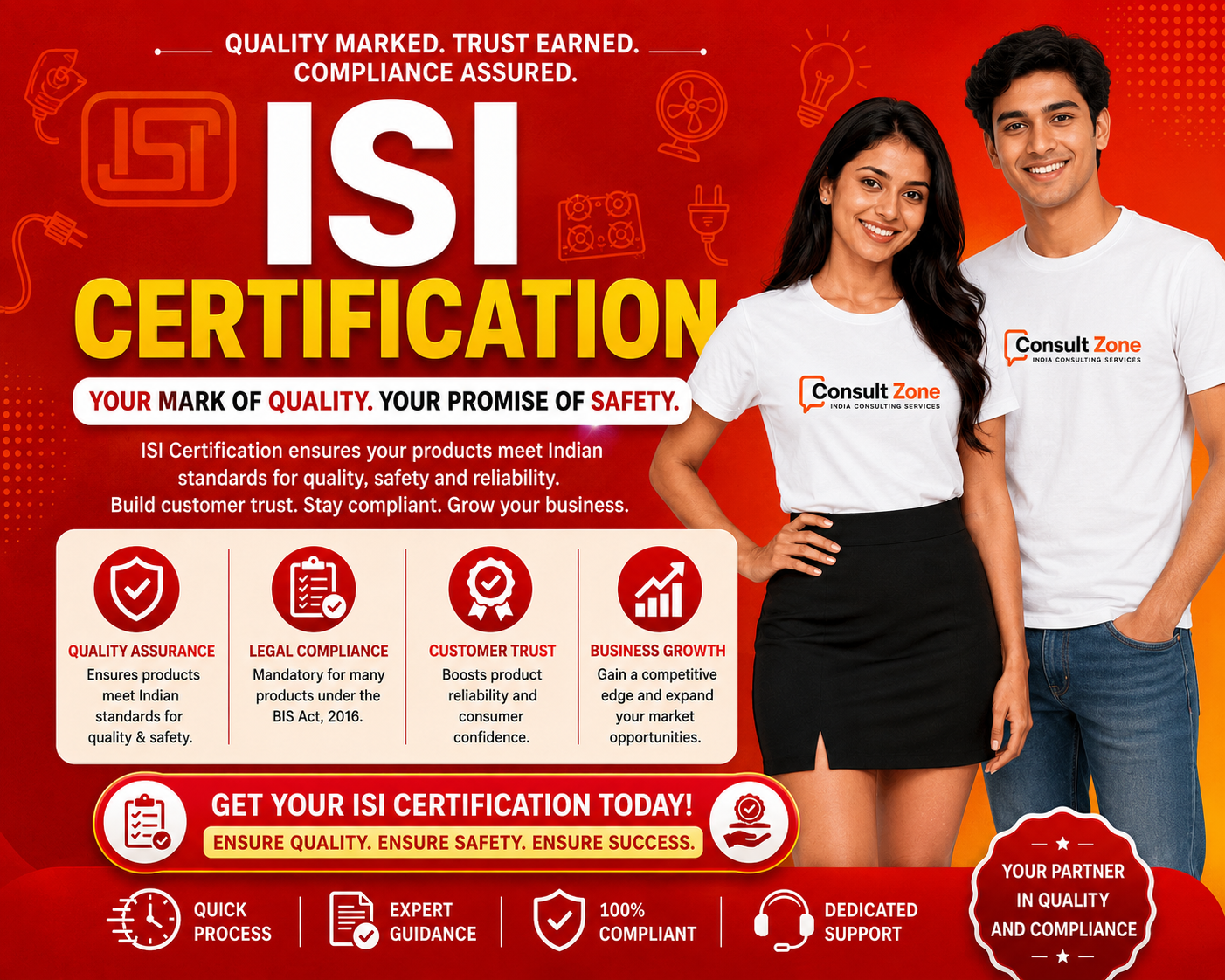
ISI Certification, represented by the well-known ISI mark, is a product certification scheme operated by the Bureau of Indian Standards (BIS) under the BIS Act, 2016. The ISI mark is one of the most recognised and trusted quality marks in India and certifies that a product conforms to the relevant Indian Standard (IS). For a wide range of notified products — such as electrical appliances, cement, helmets, LPG cylinders, packaged drinking water and steel — ISI certification is mandatory before they can be sold in the Indian market. The ISI mark assures consumers of the safety, quality and reliability of the product. At Consult Zone India, we provide complete end-to-end assistance for ISI mark certification for manufacturers.
ISI Certification is a BIS product certification that allows a manufacturer to use the ISI mark on a product, confirming that it conforms to the applicable Indian Standard.
Note: The list of products under mandatory ISI certification is decided by government notifications. To confirm if your product needs it, connect with our executive.
Q1. What is ISI certification?
ISI certification is a BIS product certification that allows the use of the ISI mark, confirming that a product conforms to the relevant Indian Standard. For your product, connect with our executive.
Q2. Is ISI certification mandatory?
ISI certification is mandatory for products notified by the government under compulsory certification. For other products it may be voluntary.
Q3. What is the difference between ISI and BIS?
BIS is the certifying body (Bureau of Indian Standards), while the ISI mark is the certification mark granted by BIS for notified manufactured products.
Q4. Is product testing required for ISI certification?
Yes. Product sample testing at a BIS-recognised laboratory is generally required as part of the certification process.
Q5. Is a factory inspection part of the process?
Yes. BIS generally conducts a factory inspection of the manufacturing unit before granting the ISI mark licence.
Q6. Can foreign manufacturers get the ISI mark?
Yes. Foreign manufacturers can obtain the ISI mark under the Foreign Manufacturers Certification Scheme (FMCS).
Q7. How long does ISI certification take?
The timeline depends on the factory inspection and sample testing. For more details, connect with our executive.
Contact us today for fast and hassle-free ISI mark certification assistance for your products!
Note:
Get a free, no-obligation consultation on WhatsApp
Your details are safe & we usually reply within minutes.